Arranging Exercise: Sharp or Flat
 Whenever you write notes that are not in the scale, you have to choose whether to use a sharp or a flat. In most instances only one of them is correct, if you take into account the harmonies. In this exercise, you will be choosing between these two.
The exercise is like this. Each time there are given two alternative notations of a short chord progression. Both versions sound the same. Point out the correct version, the left or right one:

 The language of chord symbols is not fixed. The way chords are notated differs between books and between musicians. Some people notate a minor chord with

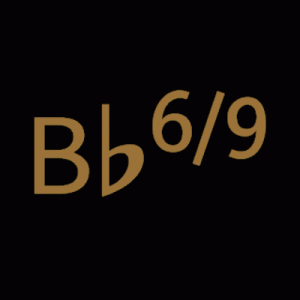 Writing chord symbols might be done with regular letters and signs, like the ones on your keyboard. But it won’t look very good. For a flat you will have to use a b, a triangle for a major seventh doesn’t exist and you won’t be able to write extensions in superscript. Creating beautiful chords is quite a job, both in a text editor and in a music notation program.
 With my choirs I tend to do a lot of arpeggio exercises in the warming-up, lately. They are kind of hard to sing, but very good for listening and blending. Here is an example of such an exercise. The arpeggio is sung from bottom-up first and then repeated from top to bottom: