Arranging Exercise: Homophonous Versus Lead and Accompaniment
 In writing an arrangement, a basic choice is what the structure of the piece will be. By this, we mean what role the different parts play in the piece. You can write all parts homophonously. Or you can let one of the parts sing the lead and have the other parts sing accompanying lines.
Much can be learned from writing a single song using these two structures. This helps you to clearly see the effect of the techniques on the sound of the piece. In this blog there is an arranging exercise for that. The song we are using is Fields of gold by Sting. The exercise is to arrange the notes twice. First, in four parts, satb homophonous. Second, in five parts, in which the melody is sung by soprano 2 and the other four part sing homophonou accompaniment.


 For singers, it is nice to be able to use their full vocal range. A singer who may only sing low notes, tends to develop a very dark sound. And reversedly, a singer who has to sing high notes all the time, tends to lose warmth. When the voices within a choir vary in color, blending gets less and intonation gets harder. Apart from that, it is much more challenging and accomplishing for singers if they can use their full range.
 In this warming-up exercise the singers are divided into two groups. In turn these groups sing a number of notes. The melody of the exercise is like this: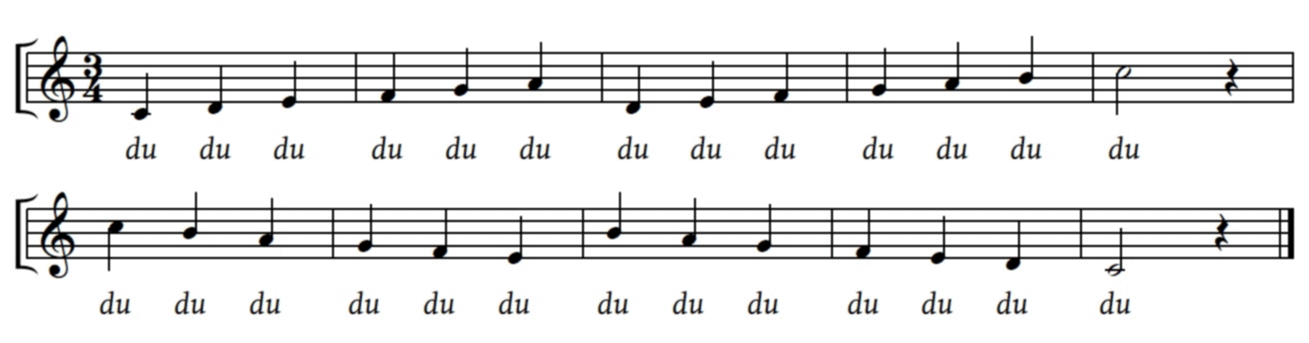
 Vocal percussion is imitating drums and percussion with the voice. This technique was developed in the eighties in hiphop music. Actually, in this music style it is called beatboxing. In the a capella world however it is called vocal percussion.
 Now and then students from the conservatory ask me what settings I’m useing for the layout of my scores. In the past twenty years I slowly developed my view on that. I’m happy to explain which choices I make.



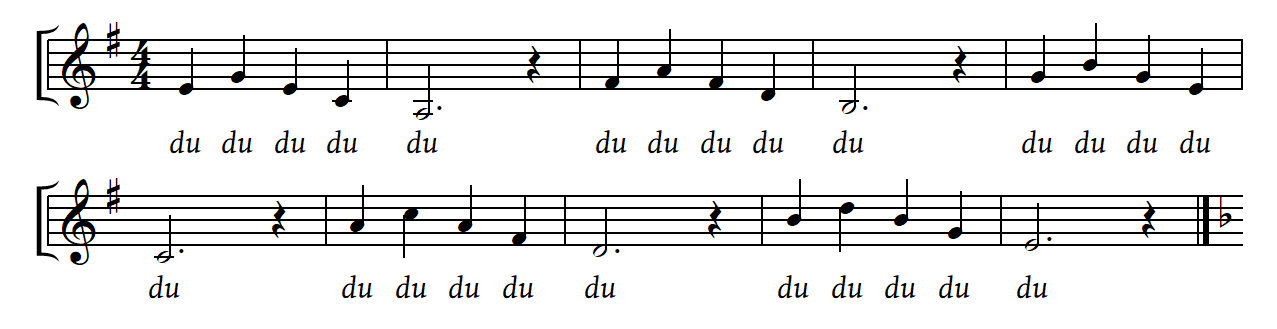
 For improving the counting of singers, I developed clapping exercises. These canons are meant to do without sheet music. The singers will learn to internally visualise the different beats of the bar.