Three-Part Warming-Up Exercise with Mediants
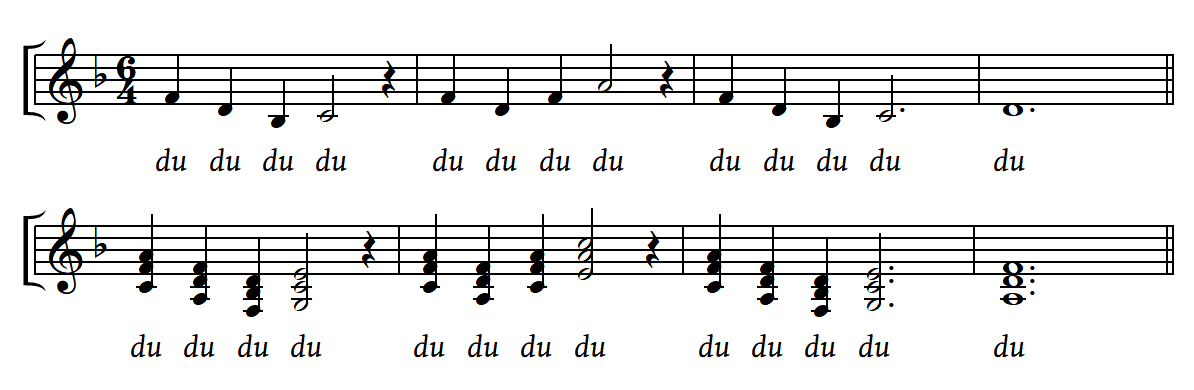
 For my female vocal group, I wrote a three-part warming-up exercise. At first, all voices are singing the melody in unison once. Next, you may sing the exercise in three parts. The lower voice is singing the exact notes from the melody, but a fourth lowered. The high voices are singing in harmony with the melody a third above:
 The time signature used most often in pop and jazz is four-four time. But in writing music, musicians often choose the note values in a bad way, so the backbeat isn’t right. According to drummers, the backbeat consists of the accents on the second and fourth beat of a four-four time. If you notate a piece of music, you should choose your notes in such a way that the second and fourth beat coincide with the backbeat.
 There are a lot of choirs with only female singers. Writing for such choirs is challenging. How do you go about writing for women’s voices? Is it possible to take an arrangement for men and simply sing it an octave higher? And if you do, does it sound the same as the men’s version? Or do other rules apply to arranging for female voices?
 Homophonic arrangements are worthwhile for a choir. In such scores, all choir members sing the same lyrics at the same time. In this way, there is a strong connection between the singers and the choir will have a strong unified performance on stage. Below are the advantages of homophonic pieces.
 In the past months, I using a new teaching form in my conducting lessons. Students used to take turns, standing in front of the group. But instead of that, now the group is forming a circle and each student gets a few minutes to work on the music. Below, I’m describing this work form in more detail.
 Most arrangers that I know, use music notation software like Sibelius or Finale, to make scores look nice. But most of the writing we tend to do at the piano. (At least, I hope so, because arranging behind the computer is a bad habbit.) Thus, writing for choir starts on paper.
 As an arranger, I try to make my scores look as beautiful as possible. I really like a good layout. My arrangements are made with the music notation software Finale. But I definitely do not use its standard layout, because for me that layout looks rather bad.
 Some musicians tend to write all extensions after the first extension between parenthesis. Thus, they would write